Page 47 - Biz X Magazine - June, 2014 Issue
P. 47
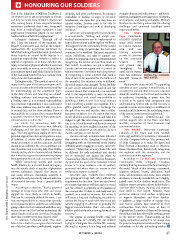
HONOURING OUR SOLDIERS Tis is the defnition of Military Resilience. I attitudes, and poor performance, becoming a struggle ofen marred with detours – self doubt, continued to ask to see a psychologist to discuss workaholic or displays of anger or pervasive mistrust, indignities, and failure; loss of identity and help me make sense of what I experienced hopelessness are signs that you may have an and purpose, and feeling vulnerable. Military afer coming home. A base surgeon’s medical injured soldier. Leaders need to be able to families are also facing unbearable life-altering assessment confrmed that I was doing well recognize these signs and work at developing challenges and emotional hardships never but, from a medical-legal viewpoint, I had resilience.” experienced before. employment limitations placed on me which Lafreniere acknowledges that mental health Dan Manu- resulted in loss of full time employment.” is a continuum. “Talking and simple non- Popa, Commander Lafreniere continues, “Trough all of medical interventions can be implemented to of HMCS HUNTER this, I had the support of the regiment, the help soldiers refocus and strengthen resilience. (since 2011) served Brigade Commander and staf at the brigade Te support from the community for the Armed in various exercises headquarters. My experiences reinforced my Forces, the Army in particular, has been and with staf and belief that looking afer soldiers with Operational continues to be excellent. Te most important training activities Stress Injuries or mental health injuries is a action individuals can take to support our in over 35 countries leadership responsibility. Whether a soldier is soldiers is to engage in civic acts of remembrance on fve continents injured on operation or at home, whether the recognizing the service and sacrifce made on between 1994 injury is mental or physical, whether it occurred their behalf. As soldiers, our job is defending and present day. prior to or while in service, on or of duty, there Canada and its sovereignty and to protect its Troughout his is an inherent moral and ethical duty for leaders national interests. Our nation had a long history naval career, Manu- of the Canadian Armed Forces to exercise their of recognizing a social contract that owed a Popa has witnessed Dan Manu-Popa - Commander, duty of care for their soldiers.” duty of care to its wounded for the lifetime of how OSI “leaves its HMCS HUNTER. Lafreniere adds, “Te medical aspect of an the wounded. Te situation today is diferent, mark.” injury is only a part of the care continuum and I, the social contract has changed. Today, the duty He shares his views on OSI. “In supporting as a commander, take seriously my responsibility of care can be measured and paid of and the members of our Canadian Armed Forces, it is for understanding all the constituent parts contract closed. Our community can ask itself necessary for communities to become educated of the duty of care and how they are related. what is the responsibility it owes the injured about the condition and not treat such members Building resilience and returning soldiers to in their ethical and moral responsibility in as anathema. Knowledge is power here, but a healthy state is a command responsibility, providing a duty of care? Tis social contract it needs to be paired with compassion and not a medical responsibility. I also understand is not something a soldier can negotiate; it is a understanding. Science tells us that recovery is that some soldiers may not be able to return gif a grateful nation gives in exchange for possible in terms of returning to a semblance of to normal duty and for those soldiers, I have a the gif of service and sacrifce that a soldier normalcy in life, however, the underlying source responsibility as a commander to ensure there is has given its nation. It is the nation that must of the trauma never leaves the individual.” a successful transition from military (even part- decide what the social contract is and what it is Delta Company (DeltaCoy.com), the time service) to a civilian life.” obliged to gif. Te other thing our community civilian support arm of the Essex and Kent He admits his interactions with the can do is to look forward and focus its support Scottish, comprises of local business and Canadian Forces Health Services were difcult, for ensuring we have resilient members of the community leaders. challenging and less than helpful. Lafreniere military, for whatever we are asked to do next Dave Woodall, (Honorary Lieutenant- says, “Te only signifcant stigma of OSI is the month, next year or next decade.” Colonel) of the Essex and Kent Scottish personal stigma that ofen accompanies a sense Various outreach initiatives have indicated (EKS.org) and former Operations Commander of isolation. A soldier with a physical injury that members of the Canadian Armed Forces of Delta Company believes “Te primary role would not hesitate to ask for assistance. An OSI (struggling with an Operational Stress Injury) of Delta Company is to make the Essex and should be no diferent. My own experience was defnitely want to engage in recovery. Lafreniere Kent Scottish a household word in Windsor, one of seeking and accepting help from family, confrms, “What this recovery looks like will Essex, Chatham-Kent, thereby fully integrating friends, and my chain of command and I believe be diferent for each individual and should the regiment with the community and the that it was this support that prevented my injury not be measured one against the other. As community with the regiment.” from getting worse and made me more resilient.” Commanding Ofcer of the Windsor Regiment, According to Cy McGrath, (Operations While researching suicide and mental my goal and the goal of the Canadian Armed Commander, Delta Company), Canadian health injuries for a second Board of Inquiry Forces is to train resilience into its military military training is some of the best training in into the suicide death of another Afghanistan personnel and where there are strains in that the world. “Much of this training – teamwork, veteran, Lafreniere learned that access to resilience, to support recovery.” situation analysis, loyalty, dedication, hard Lafreniere says, “Soldiers form informal and using afercare, (essentially support), is peer groups and help each other without the work, self-motivation and many more similar attributes, is directly transferable and a highly- currently the only statistically relevant indicator Boot Graphic credit: © istockphoto.com/big ryan message to know those who seek and accept and the attitude is generally in recognition of continue their military training and improve requirement for direction. Tere are also formal of successful recovery from a mental health prized asset to the civilian work force. Te injury. peer support groups as well that can be accessed military reserve program allows individuals to According to Lafreniere, “Tat’s a powerful the courage that it takes to seek help and put their skills in that regard. However, these part-time soldiers need civilian employment yourself on a road to recovery. For some, it support are more likely to return to health. will mean a long and challenging transition to Tis can be extremely difcult for some. I see to support themselves and their families. civilian life. Being in touch with others and pro it as my responsibility to ensure that I provide In addition, a large number of regular force an environment where soldiers are comfortable and reserve soldiers have returned to their actively engaging in afercare is probably the communities from their tours of duty in biggest recommendation that I can make for going to their chain of command with these very Afghanistan. A number of them will be leaving soldiers and their families moving forward into serious issues and that leaders understand the mental health continuum model and recognize in the private sector. Unfortunately, in this signs that a soldier is reacting, injured or ill.” Te stigma of mental health crisis still In addition, Lafreniere adds, “You don’t prevails in the 21 century. For our soldiers highly competitive world, it is not always easy for potential employers to seek out these unique have to be a doctor to recognize that increased recovery.” st the military and they also will be seeking careers trying to reintegrate into civilian life, crossing use of alcohol, avoidance, withdrawal, negative the road to recovery it is a long and arduous individuals or for the job-seeking soldiers BIZ X MAGAZINE • JUNE 2014 47 BizX2014June52.indd 47 2014-05-27 9:44 PM